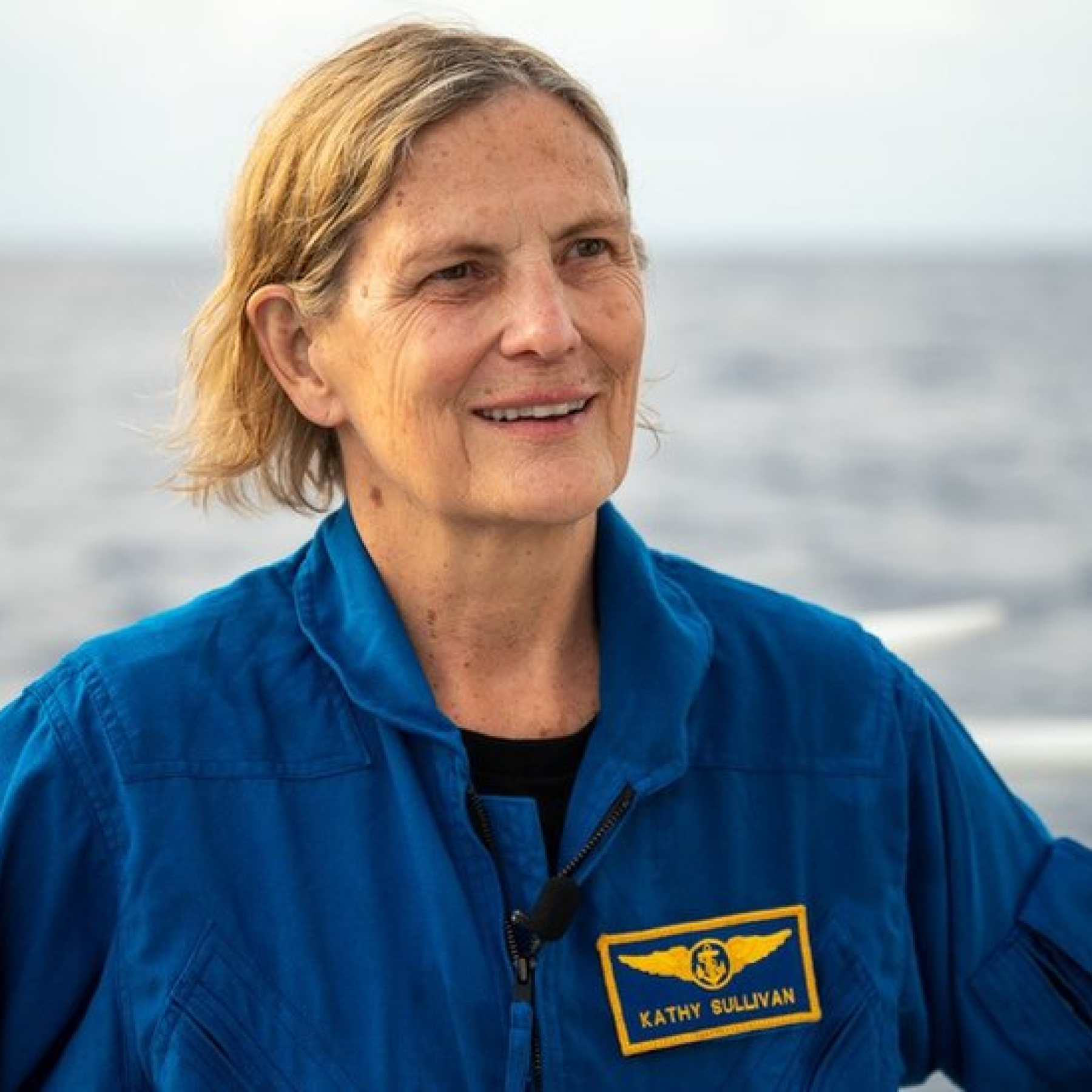
Kathy Sullivan The woman who's made history in sea and space
Kathy Sullivan The woman who's made history in sea and space
- By --
- Saturday, 24 Dec, 2022
Already in the history books as the first US woman to complete a spacewalk in 1984, the 68-year-old found herself in the news again this week after becoming the first woman to travel almost seven miles (11km) to reach the lowest known point in the ocean.
The two missions, total opposites in the minds of some, represent two extremes of a lifelong passion for Dr Sullivan: to understand the world around her as much as possible.
"I was always a pretty adventurous and curious child with interests wider and more varied than the stereotype of a little girl," Sullivan told the BBC in a phone interview from the Pacific Ocean.
She was born in New Jersey in 1951 and spent her childhood in California. Her father was an aerospace engineer who, along with her mother, would always encourage their two children to think freely and join in with discussions.
"They really fed our curiosity on anything we were curious about or interested in," she says. "They were our best allies to explore that interest further and see where it might take us: it might die out in a couple of days, it might be something that became our best hobby or it might turn into the central focus of our career."
By the time they were five or six, it was already clear her brother wanted to grow up to fly aeroplanes. Sullivan, meanwhile, became fascinated by maps and learning more about the interesting places on them.
"Both of our careers have basically been remarkably wonderful fulfilments of those early dreams," she reflects.
As a little girl, Sullivan was already devouring every newspaper, magazine and television report she could find on the subject of exploration. It was a time when Jacques Cousteau was making pioneering undersea discoveries and the Mercury Seven were propelling the image of astronauts into America's mind.
"I saw these people - they happened to all be men, that didn't bother me... I saw there are people in the world that have continually inquisitive, adventurous lives: they're going to places no-one's been and they have this store of knowledge and they're learning more."
"My way of thinking about it never crystallised into: I want that job, I want that title or that label," she explains about her ambitions as a teenager. "But what I knew really clearly was what I wanted my life to be like, I wanted it to have that mixture of inquiry and adventure and competency."
Her pursuit first took her into foreign languages and then, as an undergraduate, into the study of earth sciences. Back then, around 1970, it was an area still overwhelmingly male-dominated.
"The guys went out to field camps and they dressed all grubby and they never showered and they could swear and be real, rowdy little boys again to their hearts' content," she says. Her presence was treated like a disturbance to their fun.
Sullivan felt that by this time, there was already some change under way. She was never, for instance, harassed or bullied for her gender. "In fact, in a couple of key instances, I had some tremendously supportive male professors and colleagues that were definitely, definitely on my side and just saw me as a very capable fellow student, very capable geologist, very capable fellow shipmate."
Sullivan (second from the right) was part of the first intake of female astronauts at Nasa
Sullivan saw in her marine science professors her ambitions for her own life realised - and so began to further her studies in oceanography.
She applied to Nasa as a way to deepen her knowledge of the earth further still. "My primary motivation for applying to be an astronaut was - if I somehow beat the odds and actually got chosen - I could get to see the earth from orbit with my own eyes."
Sullivan was admitted into Nasa's class of 1978. It was the first recruitment drive that brought women into its astronaut ranks.
Six were selected from the class of 35 and Sally Ride, seen on the far left of the image above, became the first of them to fly into space in 1983.
Ride would later recount the unique challenges of being the first women recruited into the space program. Engineers tried to design special make-up kits and wildly overestimated how many tampons would be needed for week-long missions.
Sullivan's first mission, STS-41-G, set off on 5 October 1984. It was the 13th flight of Nasa's Space shuttle program and the sixth trip for the Space Shuttle Challenger.
Related News